I first encountered infra-red (IR) photography a number of years ago at a Nikon local event. It was primarily for 3D stereo images but some examples were in IR – it started an itch.
Some years later I took a bit of a plunge and bought an IR gel filter with rather indifferent results. So IR stayed off limits for about 10 more years.
I then started to look at camera conversions as the itch needed another good scratch. So after a bit of research I discovered Advance Camera Services in Norfolk. A couple of emails and a long chat with Neil and I bought a second -hand D7000 from them with a filter conversion. I have had an D7000 before, in fact I still have it as a spare. It is a lovely little thing which handles so very well. So when this one was offered it had about a 5000 shutter count and I jumped at it.

The two choices I looked at were the 720nm or 830nm. The diagram shows the light ranges for a normal visible light filtration and the two IR filters. The 730nm shows that at the bottom end a small portion of the visible spectrum is allowed past, there will be colour, albeit very reduced available. The 830nm filter blocks the entire visible spectrum and only infra-red makes it through. Because there is no real colour now the images are processed to pure black and white.

I mulled over which filter to go for the choice being 720nm or 830 nm. I decided on the 830mm which produces black and white images which is what I wanted. There is a little downside as the filter is rather dense and reduces the light by about 1.5 stops.
So, I thought I would look at books and maybe videos. Only one book gave me examples of IR images and the videos of Pete Harvey were both entertaining and informative. I doing an abebooks search I came across a small volume which was originally published in 1933. It was gel filters, specific films available and their use. It dealt with the technical aspects of the subject and gave a solid grounding in many aspects. I purchased a third edition published in 1945 which catered for the latest developments in the chemistry and physics of IR. Perhaps the most influential area was the ability of IR to penetrate haze and light mist. The book gave examples of using this characteristic particularly in aerial photography. Not only with long distance vision but to the base of clouds which have a thin layer of mist underneath. This gives a sharper view of the cloud base.
To put some flesh on describing the effects of IR, firstly let us look at the difference between haze and cloud. With haze the content is dust partcles, smoke and very fine water droplets. The IR can brodaly get through. However, cloud consists of larger water padroplets and the IR light has to pass through. The next figure is the transmission of light through water for a range og wavelengths.
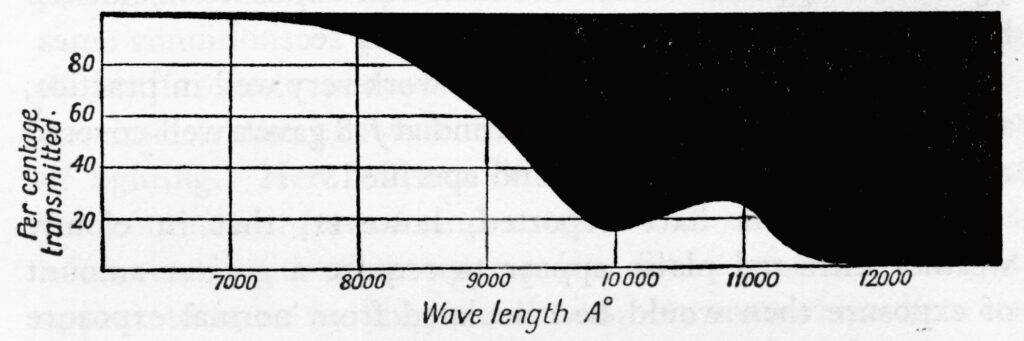
In the visible spectrum, light passes through pretty much unhindered. However, at the longer wavelengths, particularly IR the transmission is severely curtailed. This will make the clouds opaque to IR light.
Another feature is the reflecting properties of the green matter from leaves.
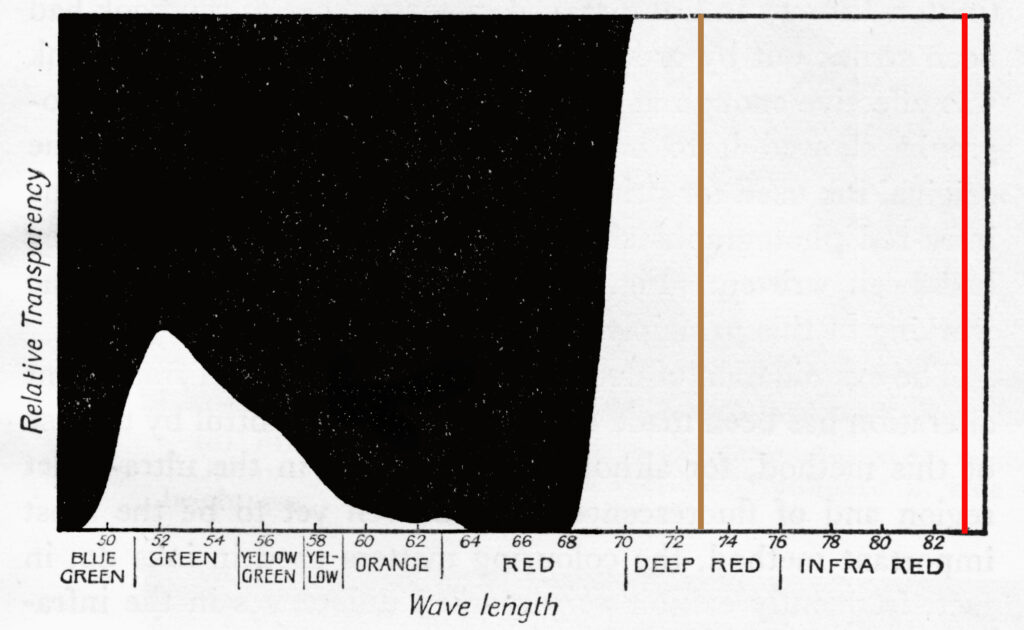
In the visible part of the spectrum, the wavelengths associated with the green of spring/summer together with the autumn hues, have a reflectance making them effective in showing the appropriate colours. However, at the longer wavelengths, associated with IR, the reflectance is virtually perfect. So a green or yellow leaf with show the correct colours however, in the IR world, the reflection is pretty much perfect and will therefore show up as white.
The figures were taken from the reference below*.
I decided to purchase a lens dedicated to this camera so as to not hit problems when using IR and normal cameras simultaneously. I wanted a Nikkor with a good zoom range. My choice was a 24mm – 120mm zoom, which with this camera equates to 36mm – 180mm. A really useful range.
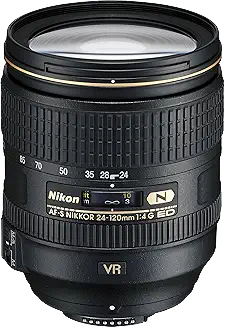
Part of the decision was concerned with a problem with some lenses. The original design was for the visible spectrum so use of IR can cause difficulties. This shows as a hotspot in the centre of the picture. There are a potential problem but there are websites which indicate whether a particular lens has this problem.
An example of a reference website is:
Lens Hotspot Database – Kolari Vision
Hot Spots are exacerbated by a high f number so use of the lens is at low f numbers.
* Reference: Infra-Red Photography, S. O. Rawling, Blackie & Son, 4th Edition, 1945.